
Lesson 8 · February 22, 1919
Experiences of Israel for Our Learning
Lesson Scripture: Psalm 106:6-20.
Daily Study Outline
- 1.Read the lesson scripture.
- 2.Study questions 1-13, and read the marginal references.
- 3.Study questions 14-21, and read the marginal references.
- 4.Study questions 22-28, and read the marginal references.
- 5.Study the notes.
- 6.Review the lesson.
- 7.Study the similarity of the experiences of the church to-day to that of ancient Israel.
American Revised Version of Lesson Scripture
6 We have sinned with our fathers,
We have committed iniquity, we have done wickedly.
7 Our fathers understood not Thy wonders in Egypt;
They remembered not the multitude of Thy loving-kindnesses,
But were rebellious at the sea, even at the Red Sea.
8 Nevertheless He saved them for His name's sake,
That He might make His mighty power to be known.
9 He rebuked the Red Sea also, and it was dried up:
So He led them through the depths, as through a wilderness.
10 And He saved them from the hand of him that hated them,
And redeemed them from the hand of the enemy.
11 And the waters covered their adversaries;
There was not one of them left.
12 Then believed they His words;
They sang His praise.
13 They soon forgat His works;
They waited not for His counsel,
14 But lusted exceedingly in the wilderness,
And tempted God in the desert.
15 And He gave them their request,
But sent leanness into their soul.
16 They envied Moses also in the camp,
And Aaron the saint of Jehovah.
17 The earth opened and swallowed up Dathan,
And covered the company of Abiram.
18 And a fire was kindled in their company;
The flame burned up the wicked.
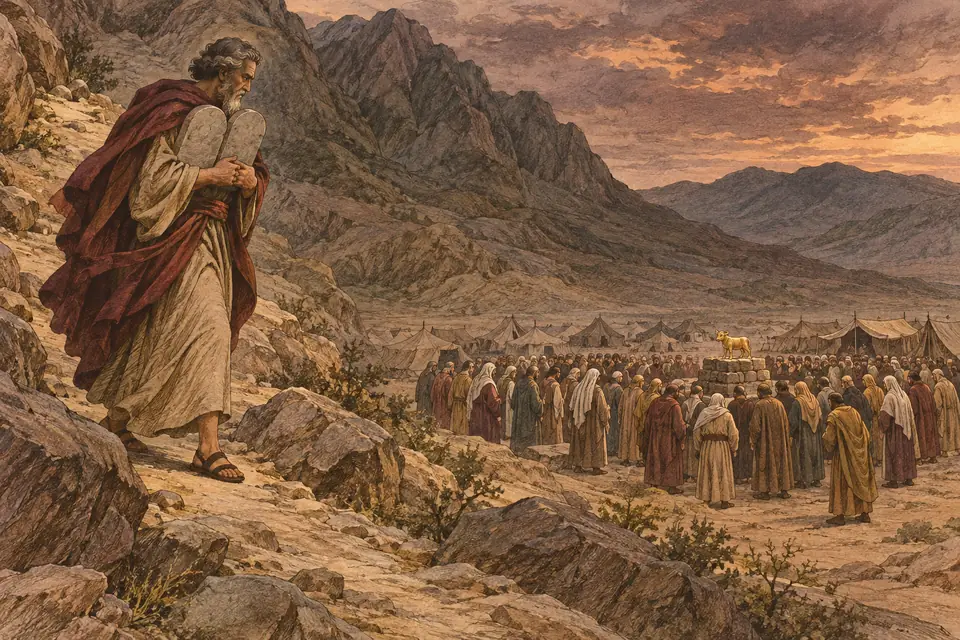
19 They made a calf in Horeb,
And worshiped a molten image.
20 Thus they changed their glory
For the likeness of an ox that eateth grass.
Questions
- 1.In what respect, did the psalmist say, were their descendants like the fathers?
- 2.What other confession was made?
- 3.What did the fathers fail to understand?
- 4.What did they forget?
- 5.Where did their rebellious spirit break forth?
- 6.What did God do for them? Why?
- 7.What was His purpose in all this?
- 8.What did God do to the Red Sea? What was the result?
- 9.How easily were they then brought through the sea?
- 10.From what were they thus saved?
- 11.From whom were they redeemed?
- 12.With what experience did their enemies meet?
- 13.How complete was their destruction?
- 14.What influence did this have upon the faith of God's people?
- 15.How did they give expression to their feelings?
- 16.How long did they maintain this attitude toward God?
- 17.What shows their headstrong impatience?
- 18.What did they do?
- 19.How is their conduct toward God characterized?
- 20.What response did God make to their demands?
- 21.What experience came upon them as a consequence?
- 22.How did the people treat Moses and Aaron?
- 23.What judgment came upon Dathan?
- 24.What happened to Abiram and his friends?
- 25.What other judgment came upon the people?
- 26.What was the result of this judgment?
- 27.How did they show that their hearts had not been converted from the idolatrous practices of Egypt?
- 28.In what way did they express their estimate of their Deliverer?
Notes
This psalm opens with an exhortation to praise and thanksgiving, and the acknowledgment that God's people to-day are repeating the history of His chosen people in the wilderness.
Verse 7. Observe how extensively this experience is being repeated in the lives of the majority of professed Christians. How rarely the multitude of God's mercies are recounted! This is the source of strength, the means by which Satan will always be defeated.
Verse 8. God is now gathering out a people for His name. Acts 15:14. Not only may we be among that people, but we may share in gathering them, with this closing message, from every nation, kindred, tongue, and people. Through this people, God will make known His mighty power; for He will vindicate His righteous character before the universe. This is the highest reason that can be assigned for God's great love in pardoning and saving sinners. Compare Ezek. 36:22, 32; Isa. 43:25; 48:9; Jer. 14:7; Ps. 6:4; 23:3; 25:11; 31:16.
The song of Moses (Ex. 15:1-18) does not belong to the Jewish people alone. It points forward to the final victory, when the Israel of God will sing not only the song of Moses, but the song of the Lamb (Rev. 15:2, 3). Those who will sing that song of triumph then must learn to sing it now. Ps. 50:23; 67:5; 146:2.
"The history of the wilderness life of Israel was chronicled for the benefit of the Israel of God to the close of time. The varied experience of the Hebrews was a school of preparation for their promised home in Canaan. God would have His people in these days review with a humble heart and teachable spirit the trials through which ancient Israel passed, that they may be instructed in their preparation for the heavenly Canaan."
On the significance of their idolatrous worship, "Patriarchs and Prophets," appendix, note 7, page 760, says:
"The golden calf was a representation of the sacred bull called Apis, which the Egyptians worshiped, and with which the Israelites had necessarily become very familiar during their long sojourn in Egypt. Concerning this god Apis and what it signified, we find the following:
"'Apis, the bull worshiped by the ancient Egyptians, who regarded it as a symbol of Osiris, the god of the Nile, the husband of Isis, and the great divinity of Egypt.' "—Chambers's Encyclopedia.
Bible texts in this lesson
Psalms 106:6-20 · Psalms 106:7 · Psalms 106:8 · Acts 15:14 · Ezekiel 36:22 · Ezekiel 36:32 · Isaiah 43:25 · Isaiah 48:9 · Jeremiah 14:7 · Psalms 6:4 · Psalms 23:3 · Psalms 25:11 · Psalms 31:16 · Exodus 15:1-18 · Revelation 15:2 · Revelation 15:3 · Psalms 50:23 · Psalms 67:5 · Psalms 146:2
My notes
Saved in this browser. Sign in to see your notes on other devices.