
Lesson 11 · June 15, 1918
The Message of the Sanctuary and Its Cleansing
Daily Study Outline
| Day | Study | Questions |
|---|---|---|
| Sabbath | Read "Great Controversy," pages 40-56, 428-434. | |
| Sunday | Empire passing from east to west | Ques. 1, 2 |
| Monday | The horns and the "little horn" | Ques. 3-5 |
| Tuesday | The belittling of the heavenly priesthood and sanctuary | Ques. 6, 7 |
| Wednesday | Restoring the truth from papal darkness | Ques. 8-10 |
| Thursday | The reward when the sanctuary is cleansed | Ques. 11-13 |
| Friday | Review the lesson. |
Questions
- 1.In the year that Babylon fell, what appeared to Daniel? Dan. 8:1, 2.
- 2.What is symbolized by the ram and the he-goat? Verses 3-8, 20, 21.
- 3.In what form was the Grecian empire to exist for a time? Verses 8, 22.
- 4.What power was represented by the other horn of verses 9, 23, 24? Note 1.
- 5.What would he do to God's faithful people? Verses 10, 24. Note 2.
- 6.What would he do to Christ and His heavenly sanctuary service? Verse 11. Compare Rev. 13:6. Note 3.
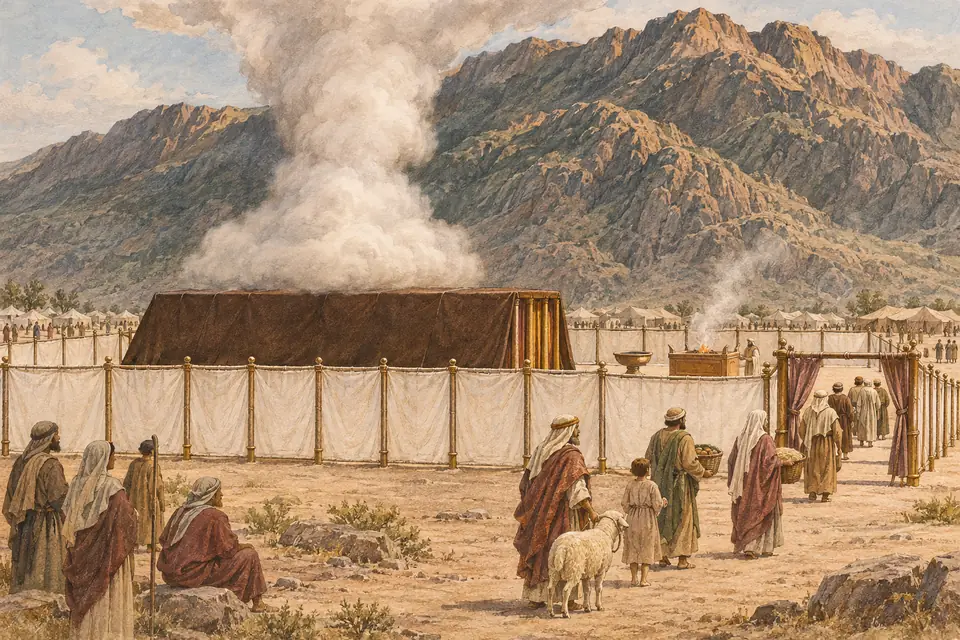
- 7.To what time would this be allowed to continue? Dan. 8:13, 14.
- 8.By what event would God's people and law be freed from the domination of the papacy? Dan. 7:26.
- 9.What, then, must constitute the cleansing of the sanctuary? Note 4.
- 10.At the time of the Judgment, what change in ministration did Jesus, our great High Priest, make? Rev. 11:18, 19. Note 5.
- 11.At the conclusion of the Judgment, what will be given to God's faithful children? Verse 18.
- 12.What incentive is held out to those who, by a study of the priestly work of Christ, are being drawn near to Him? Rev. 22:12.
- 13.What is the crowning blessing that is to come to those who are delivered from the deceptions and bondage in modern Babylon? Verses 3-5.
Notes
1. "The interpretation already given to this vision shows plainly that the power represented by the little horn is the successor of Medo-Persia and Grecia. In the vision of the seventh chapter of Daniel, which is closely related to this vision, the fourth beast represented the fourth kingdom, or Rome, in its entirety, special attention, however, being given to the 'little horn' phase of its history. As shown by the work attributed to it, this little horn, which arose among the ten kingdoms into which Rome was divided, was to be a religio-political power, which was to change the times and law of God, and persecute the people of God. In the vision of the eighth chapter, the ecclesiastical features of this fourth world power are especially noticed and emphasized, and hence the only symbol there used to represent it is the 'little horn' which waxed 'exceeding great.' . . . The little horn of the eighth chapter represents Rome, both pagan and papal, in its ecclesiastical aspect, with its union of paganism, and later of apostate Christianity, with the secular power; with its antichristian persecutions of the saints of God; with its perversion of the priesthood of Christ; and with its assertion of both temporal and spiritual power over all the world. It is evident . . . that the emphasis is to be placed upon the fulfillment of the prophecy in the work of papal Rome. A careful comparison of Dan. 7:21, 25, with Dan. 8:10-12, R. V., and 2 Thess. 2:3, 4, will amply justify this conclusion."—"Bible Readings," edition of 1916, page 227.
2. "The Scriptural ordinance of the Lord's Supper had been supplanted by the idolatrous sacrifice of the mass. Papal priests pretended, by their senseless mummery, to convert the simple bread and wine into the actual 'body and blood of Christ.' With blasphemous presumption, they openly claimed the power of creating God, the Creator of all things. Christians were required, on pain of death, to avow their faith in this horrible, Heaven-insulting heresy. Multitudes who refused were given to the flames. . . . In their secret councils, Satan and his angels controlled the minds of evil men, while unseen in the midst stood an angel of God, taking the fearful record of their iniquitous decrees, and writing the history of deeds too horrible to appear to human eyes. 'Babylon the great' was 'drunken with the blood of the saints.' The mangled forms of millions of martyrs cried to God for vengeance upon that apostate power."—"Great Controversy," pages 59, 60.
3. "The accession of the Roman Church to power marked the beginning of the Dark Ages. As her power increased, the darkness deepened. Faith was transferred from Christ, the true foundation, to the pope of Rome. Instead of trusting in the Son of God for forgiveness of sins and for eternal salvation, the people looked to the pope, and to the priests and prelates to whom he delegated authority. They were taught that the pope was their earthly mediator, and that none could approach God except through him; and further, that he stood in the place of God to them, and was therefore to be implicitly obeyed. . . . Thus the minds of the people were turned away from God to fallible, erring, and cruel men, nay, more, to the prince of darkness himself, who exercised his power through them. Sin was disguised in a garb of sanctity."—Id., page 55.
4. In Dan. 7:26, the papal power is said to be broken by the sitting of the Judgment; and the same result would follow the cleansing of the sanctuary. Therefore these two must be different expressions for the same work, since the same results follow from each.
5. " 'The temple of God was opened in heaven, and there was seen in His temple the ark of His testament.' The ark of God's testament is in the holy of holies, the second apartment of the sanctuary. . . . Those who by faith followed their great High Priest, as He entered upon His ministry in the most holy place, beheld the ark of His testament. As they had studied the subject of the sanctuary, they had come to understand the Saviour's change of ministration, and they saw that He was now officiating before the ark of God, pleading His blood in behalf of sinners."—Id., page 433.
Bible texts in this lesson
Daniel 8:1 · Daniel 8:2 · Daniel 8:3-8 · Daniel 8:20 · Daniel 8:21 · Daniel 8:8 · Daniel 8:22 · Daniel 8:9 · Daniel 8:23 · Daniel 8:24 · Daniel 8:10 · Daniel 8:11 · Revelation 13:6 · Daniel 8:13 · Daniel 8:14 · Daniel 7:26 · Revelation 11:18 · Revelation 11:19 · Revelation 22:12 · Revelation 22:3-5 · Daniel 7:21 · Daniel 7:25 · Daniel 8:10-12 · 2 Thessalonians 2:3 · 2 Thessalonians 2:4
My notes
Saved in this browser. Sign in to see your notes on other devices.