
Lesson 4 · January 26, 1918
The Sanctuary in the Wilderness—Its Construction and General Services
Daily Study Outline
| Day | Study | Questions |
|---|---|---|
| Sabbath | Read Exodus 25; "Patriarchs and Prophets," chapter 30. | |
| Sunday | The purpose and pattern of the sanctuary | Ques. 1-3 |
| Monday | Its dimensions and coverings | Ques. 4, 5 |
| Tuesday | The ark of the testament, or testimony | Ques. 6, 7 |
| Wednesday | Order and service in the first and second apartments | Ques. 8-11 |
| Thursday | The day of atonement | Ques. 12-16 |
| Friday | Review the lesson. |
Questions
- 1.For what purpose was the sanctuary built? Ex. 25:8. Note 1.
- 2.What materials were required for its construction? Verses 1-7.
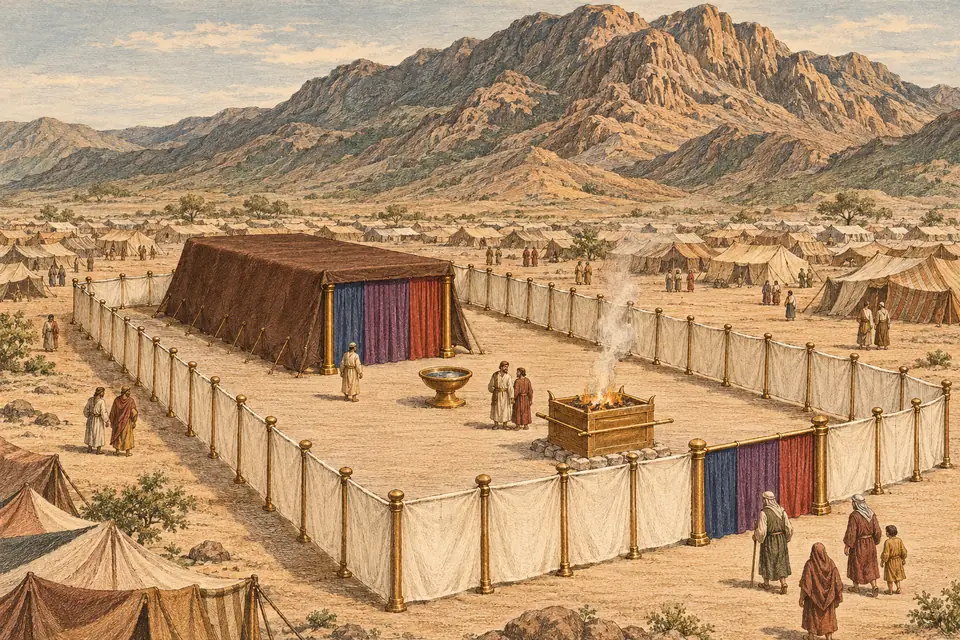
- 3.According to what pattern was the earthly sanctuary made? Verses 9, 40; Heb. 8:5.
- 4.What were the dimensions of the tabernacle, and how was it divided? Ex. 26:15-23, 33; Heb. 9:2, 3. Note 2.
- 5.What four coverings were provided for it? Ex. 26:1, 7, 14.
- 6.Describe the ark. For what purpose was it made? Ex. 25:10, 11, 17, 21. Note 3.
- 7.Where was the ark placed? Ex. 26:33, 34.
- 8.What was put in the holy place? Ex. 40:22-27. Note 4.
- 9.How often did the priests officiate in the first apartment and at the altar of burnt offering? Ex. 30:1, 7, 8; Heb. 9:6.
- 10.What daily service was performed by the priests? Ex. 29:38, 39, 42; 30:7, 8. Note 5.
- 11.How often did the high priest enter the most holy place? Heb. 9:7. Note 6.
- 12.What yearly service did he perform? Ex. 30:10; Lev. 16:17, 18.
- 13.When did that occur, and what was that occasion called? Lev. 23:27, 28.
- 14.Give a brief account of the ceremony performed that day. Lev. 16:3-28.
- 15.What should be done for the people on that day? Verses 29-34.
- 16.To what did these daily and yearly services point? Heb. 8:1, 2; Dan. 8:14.
Notes
1. As is plainly shown by Ex. 25:8, the term "sanctuary" signifies a holy or sacred place, a dwelling place for the Most High.
2. From these specifications, it is generally estimated that the tabernacle was three times as long as it was broad. The cubit is variously placed from eighteen to twenty-two inches. Taking the average of twenty inches would make the structure about fifty-five feet in length by one third that amount in breadth, and the height equal to the width. The holy place was twice as large as the most holy place.
3. "The law of God, enshrined within the ark, was the great rule of righteousness and judgment. That law pronounced death upon the transgressor; but above the law was the mercy seat, upon which the presence of God was revealed, and from which, by virtue of the atonement, pardon was granted to the repentant sinner. Thus in the work of Christ for our redemption, symbolized by the sanctuary service, 'mercy and truth are met together; righteousness and peace have kissed each other.' "—"Patriarchs and Prophets," page 349.
4. "No language can describe the glory of the scene presented within the sanctuary,—the gold-plated walls reflecting the light from the golden candlestick, the brilliant hues of the richly embroidered curtains with their shining angels, the table, and the altar of incense, glittering with gold; beyond the second veil the sacred ark, with its mystic cherubim, and above it the holy Shekinah, the visible manifestation of Jehovah's presence; all but a dim reflection of the glories of the temple of God in heaven, the great center of the work for man's redemption."—Id., page 349.
5. "The daily service consisted of the morning and evening burnt offering, the offering of the sweet incense on the golden altar, and the special offerings for individual sins. And there were also offerings for sabbaths, new moons, and special feasts.
"Every morning and evening a lamb of a year old was burned upon the altar, with its appropriate meat offering, thus symbolizing the daily consecration of the nation to Jehovah, and their constant dependence upon the atoning blood of Christ. God expressly directed that every offering presented for the service of the sanctuary should be 'without blemish.' The priests were to examine all animals brought as a sacrifice, and were to reject every one in which a defect was discovered. Only an offering 'without blemish' could be a symbol of His perfect purity who was to offer Himself as 'a lamb without blemish and without spot.' The apostle Paul points to these sacrifices as an illustration of what the followers of Christ are to become. He says, 'I beseech you therefore, brethren, by the mercies of God, that ye present your bodies a living sacrifice, holy, acceptable unto God, which is your reasonable service.' We are to give ourselves to the service of God, and we should seek to make the offering as nearly perfect as possible. God will not be pleased with anything less than the best we can offer. Those who love Him with all the heart, will desire to give Him the best service of the life, and they will be constantly seeking to bring every power of their being into harmony with the laws that will promote their ability to do His will."—Id., pages 352, 353.
6. "No mortal eye but that of the high priest was to look upon the inner apartment of the sanctuary. Only once a year could the priest enter there, and that after the most careful and solemn preparation. With trembling he went in before God, and the people in reverent silence awaited his return, their hearts uplifted in earnest prayer for the divine blessing. Before the mercy seat the high priest made the atonement for Israel; and in the cloud of glory, God met with him. His stay here beyond the accustomed time filled them with fear, lest because of their sins or his own he had been slain by the glory of the Lord."—Id., page 352.
Bible texts in this lesson
Exodus 25 · Exodus 25:8 · Exodus 25:1-7 · Exodus 25:9 · Exodus 25:40 · Hebrews 8:5 · Exodus 26:15-23 · Exodus 26:33 · Hebrews 9:2 · Hebrews 9:3 · Exodus 26:1 · Exodus 26:7 · Exodus 26:14 · Exodus 25:10 · Exodus 25:11 · Exodus 25:17 · Exodus 25:21 · Exodus 26:34 · Exodus 40:22-27 · Exodus 30:1 · Exodus 30:7 · Exodus 30:8 · Hebrews 9:6 · Exodus 29:38 · Exodus 29:39 · Exodus 29:42 · Hebrews 9:7 · Exodus 30:10 · Leviticus 16:17 · Leviticus 16:18 · Leviticus 23:27 · Leviticus 23:28 · Leviticus 16:3-28 · Leviticus 16:29-34 · Hebrews 8:1 · Hebrews 8:2 · Daniel 8:14
My notes
Saved in this browser. Sign in to see your notes on other devices.