
Lesson 2 · October 13, 1917
Signs of Christ's Coming
Daily Study Outline
| Day | Study | Questions |
|---|---|---|
| Sabbath | Read "The Great Controversy," pages 304-316. | |
| Sunday | How we may know that the Lord's coming is near | Ques. 1-3 |
| Monday | Great earthquake and darkening of the sun | Ques. 4-6 |
| Tuesday | Other signs | Ques. 7-11 |
| Wednesday | Moral and social condition of the world | Ques. 12 |
| Thursday | Warning given to God's people | Ques. 13, 14 |
| Friday | Review the lesson. |
Questions
- 1.What has the Lord promised to give so that the people may know when His coming is near? Luke 21:25-27.
- 2.Where will the signs be seen, and what will be their nature? Matt. 24:29.
- 3.What definite information concerning our Lord's return has been withheld? Verse 36. Note 1.
- 4.What signs were to be seen in the heavens? At what time were these signs to appear? Verse 29. Note 2.
- 5.What sign was to precede the darkening of the sun? Rev. 6:12.
- 6.What great earthquake occurred at the right time to fulfill this prophecy? Note 3.
- 7.What other remarkable sign in the heavens was to be a witness to the nearness of Christ's coming? Verse 13.
- 8.By what event was this prediction fulfilled? Note 4.
- 9.What does Jesus say we should do when we see these signs fulfilling? Luke 21:28.
- 10.What lesson of assurance may we draw from nature? Verses 29-31.
- 11.What does Jesus say concerning the generation that should see these signs? Matt. 24:34, 35. Note 5.
- 12.What description is given of the moral and social condition of the world just before His coming? Verses 37-39.
- 13.What warning does our Lord give His people at such a time as this? Luke 21:34, 35.
- 14.What duty is enjoined? Verse 36. See also Luke 12:35, 36.
Notes
1. "The day and the hour of His coming Christ has not revealed. He stated plainly to His disciples that He Himself could not make known the day or the hour of His second appearing. Had He been at liberty to reveal this, why need He have exhorted them to maintain an attitude of constant expectancy? There are those who claim to know the very day and hour of our Lord's appearing. Very earnest are they in mapping out the future. But the Lord has warned them off the ground they occupy. The exact time of the second coming of the Son of man is God's mystery."—"The Desire of Ages," page 632.
2. "What rendered this more striking was the fact that the time of its fulfillment had been definitely pointed out. In the Saviour's conversation with His disciples upon Olivet, after describing the long period of trial for the church,—the 1,260 years of papal persecution, concerning which He had promised that the tribulation should be shortened,—He thus mentioned certain events to precede His coming, and fixed the time when the first of these should be witnessed: 'In those days, after that tribulation, the sun shall be darkened, and the moon shall not give her light.'"—"The Great Controversy," page 306.
"The dark day of May 19, 1780, so called on account of a remarkable darkness on that day, extending over all New England. The true cause of this remarkable phenomenon is not known."—"Webster's Dictionary," edition of 1869.
"On the nineteenth of May, 1780, an uncommon darkness took place all over New England, and extended to Canada. It continued about fourteen hours, or from ten o'clock in the morning till midnight. The darkness was so great that people were unable to read common print, or tell the time of day by their watches, or to dine, or to transact their ordinary business, without the light of candles. Similar days have occasionally been known, though inferior in the degree or extent of their darkness. The causes of these phenomena are not known. They certainly were not the result of eclipses."—Robert Sear's "Guide to Knowledge."
"The nineteenth of May, 1780, was unprecedented in New England for its great darkness. . . . The darkness extended over several thousand square miles, though differing much in intensity in different places. Nowhere, perhaps, was it greater than in this vicinity. The day was appropriately called and is still known as the dark day."—"History of the Town of Hampton, New Hampshire," by Joseph Dorr, Salem, Massachusetts, printed by the Salem Press and Printing Company, 1893, volume 1, page 217.
"There appears to have been absence of clouds for the most part, though light rain occurred. Though known as the 'Black Friday of New England,' the area covered by darkness also extended west of that section."—"Encyclopedia Americana," the Americana Company, New York, 1903, article "Dark Day."
"The darkness of the following evening was probably as deep and dense as ever had been observed since the Almighty first gave birth to light; it wanted only palpability to render it as extraordinary as that which overspread the land of Egypt in the days of Moses. If every luminous body in the universe had been shrouded in impenetrable shades, or struck out of existence, it was thought the darkness could not have been more complete. A sheet of white paper, held within a few inches of the eyes, was equally invisible with the blackest velvet."—Article by R. M. Devens, "Our First Century," 1776-1876; "Great and Memorable Events," pages 89-96.
3. A few years preceding the darkening of the sun, on November 1, 1755, occurred one of the greatest of earthquakes known in history. It is commonly known as the Lisbon earthquake, because the greatest loss of life occurred in that city; but the area of its agitation was over four million square miles. About ninety thousand persons lost their lives on that fatal day. A large part of Europe and north Africa was shaken, and the agitation was felt as far north as Greenland and as far west as the West Indies.
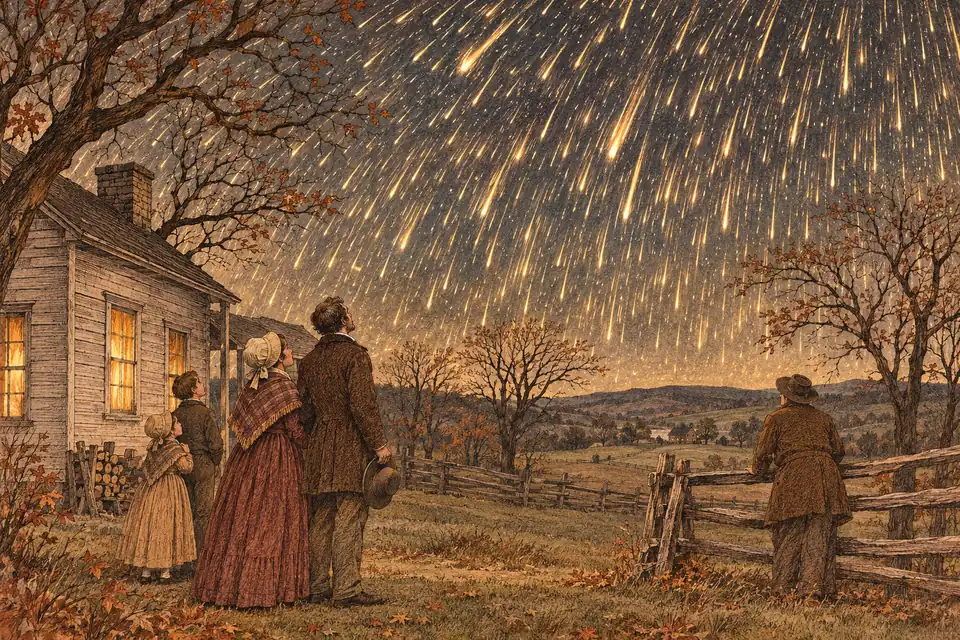
4. "The most sublime phenomenon of shooting stars, of which the world has furnished any record, was witnessed throughout the United States on the morning of the thirteenth of November, 1833. The extent of this astonishing exhibition has not been precisely ascertained; but it covered no inconsiderable part of the earth's surface. . . . The whole heavens seemed in motion, and suggested to some the awful grandeur of the image employed in the Apocalypse, upon the opening of the sixth seal, when the stars of heaven fell unto the earth, even as a fig tree casteth her untimely figs when she is shaken of a mighty wind.'"—Burritt's "Geography of the Heavens," pages 157, 158.
"No philosopher or scholar has told or recorded an event, I suppose, like that of yesterday morning. A prophet 1,800 years ago foretold it exactly, if we will be at the trouble of understanding stars falling to mean falling stars."—Article in New York Journal of Commerce, November 14, 1833.
"Compared with the splendors of this celestial exhibition, the most brilliant rockets and fireworks of art bore less relation than the twinkling of the most tiny star to the broad glare of the sun. The whole heavens seemed in motion; and little need have been borrowed from the morbid sensibility, to imagine that the opening of the sixth seal was indeed at hand, when the stars of heaven fell unto the earth, even as a fig tree casteth her untimely figs, when she is shaken of a mighty wind. Never before has it fallen to our lot to observe a phenomenon so magnificent and sublime."—New York Commercial Advertiser, quoted in the Eastern Argus (Portland, Maine) of November 18, 1833.
"We pronounce the raining fire which we saw on Wednesday morning last an awful type—a sure forerunner—a merciful sign of that great and dreadful day which the inhabitants of the earth will witness when the sixth seal shall be opened.
"That time is just at hand described not only in the New Testament but in the Old; and a more correct picture of a fig tree casting its leaves when blown by a mighty wind, it was not possible to behold.
"Many things now occurring upon the earth tend to convince us that we are in the 'latter days.' This exhibition we deem to be a type of an awful day fast hurrying upon us. This is our sincere opinion; and what we think, we are not ashamed to tell."—The Old Countryman, New York, printed in the New York Star, and quoted in the Portland (Maine) Evening Advertiser, November 26, 1833.
5. "Christ has given signs of His coming. He declares that we may know when He is near, even at the doors. He says of those who see these signs, 'This generation shall not pass, till all these things be fulfilled.' These signs have appeared. Now we know of a surety that the Lord's coming is at hand."—"The Desire of Ages," page 632.
Bible texts in this lesson
Luke 21:25-27 · Matthew 24:29 · Matthew 24:36 · Revelation 6:12 · Revelation 6:13 · Luke 21:28 · Luke 21:29-31 · Matthew 24:34 · Matthew 24:35 · Matthew 24:37-39 · Luke 21:34 · Luke 21:35 · Luke 21:36 · Luke 12:35 · Luke 12:36
My notes
Saved in this browser. Sign in to see your notes on other devices.