
Lesson 11 · June 16, 1917
On the Island of Malta; Arrival at Rome
Daily Study Outline
| Day | Study | Questions |
|---|---|---|
| Sabbath | Read the lesson scripture. "Acts of the Apostles," pp. 443-449. | |
| Sunday | Introduction to Malta | Ques. 1-4 |
| Monday | Witnessing to the barbarians | Ques. 5-9 |
| Tuesday | Resuming the journey | Ques. 10, 11 |
| Wednesday | Paul at Rome | Ques. 12-15 |
| Thursday | Lessons for us | Ques. 1-3 |
| Friday | Review. |
Lesson Scripture: Acts 28:1-16.
Memory Verse: "They shall take up serpents; and if they drink any deadly thing, it shall not hurt them; they shall lay hands on the sick, and they shall recover." Mark 16:18.
The Narrative
- 1.What did the shipwrecked party learn on getting ashore? Acts 28:1. Note 1.
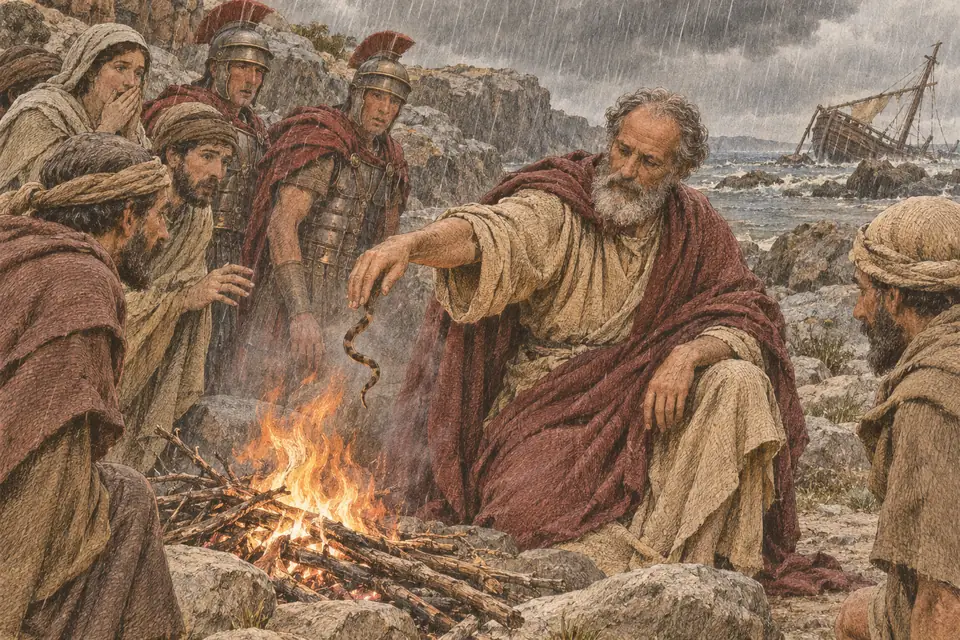
- 2.How does Luke describe the people of the island? What was their attitude? What made the fire particularly welcome to the castaways? Verse 2. Note 2.
- 3.What part did Paul act in making things comfortable? What befell him in this work? Verse 3. Note 3.
- 4.What did the islanders see? What was their thought? Verse 4.
- 5.What did Paul do? What is said of the effect of the viper's bite? Verse 5.
- 6.What did the people expect soon to see? When nothing came of it, what did they say? Verse 6.
- 7.Who had quarters in this part of the island? What did he do? Verse 7.
- 8.What blessing came to the hospitable Publius? Verse 8. Note 4.
- 9.What work followed this manifestation of God's power? Verse 9.
- 10.How did the islanders generally treat the party? Verse 10.
- 11.How long did the soldiers and the prisoners remain on Malta? By what means and course did they journey to Italy? Verses 11-13. Note 5.
- 12.Whom did Paul and his companions find at Puteoli? What did these believers desire? Verse 14. Note 6.
- 13.Toward what city were those of Paul's party journeying? What word must have gone on to the believers in Rome? What did some of them do? Verses 14, 15.
- 14.How did this meeting with the brethren from Rome affect the apostle? Verse 15. Note 7.
- 15.On arrival at Rome, what disposition was made of the prisoners? Verse 16.
Lessons for Us
- 1.Wherever the child of God may be, he is under the care of his ever present Saviour. Verse 5; Mark 16:18; Ps. 139:1-3, 9, 10.
- 2.Whether temporarily or permanently settled in a place, every place is a missionary field. Acts 28:9; 2 Cor. 2:14; 4:10.
- 3.God having promised to bring Paul to Rome (Acts 23:11), no storms could keep him from reaching that city. Even so no storms of opposition can keep the trusting believer from the overcomer's portion in the city of God. Rev. 3:21.
Notes
1. The modern name is Malta, now a British naval station. It is sixty miles from the island of Sicily, and two hundred from the African coast. A bay on the north side of the island has been named St. Paul's Bay, where it is supposed the party landed.
2. To the Greeks, all were "barbarians" who did not speak Greek. The people were of Phoenician origin. It was probably late in October, and already the chill nights and mornings of autumn had begun. The kindness shown by the islanders was repaid in blessings later.
3. Worn with watchings and exertion, the aged apostle was nevertheless not one to sit quietly while work was to be done. He was "instant in season" not only in preaching the Word, but in doing any other task.
4. Weymouth's translation: "Now in the same part of the island there were estates belonging to the governor, whose name was Publius. He welcomed us to his house, and for three days generously made us his guests. It happened, however, that his father was lying ill of dysentery aggravated by attacks of fever; so Paul went to see him, and, after praying, laid his hands on him and cured him."
5. November, December, and January had been spent in Malta, evidently; and with early February, the Alexandrian grain ships were again moving toward Italy. Syracuse was the great port of Sicily; and at Rhegium, at the toe of the Italian boot, the apostle first touched Italy. The company landed at Puteoli, on the present Bay of Naples.
6. The apostle may have stopped the seven days in order to spend the Sabbath with the believers, even as once before he had tarried at Troas seven days (Acts 20:6, 7) in order to spend a Sabbath there, leaving early Sunday morning.
7. Paul was always cheering others on. It was because he drew courage for himself from every token of God's goodness and every memory of Christ's loving grace.
"It was with a heavy heart that Paul went forward to his long expected visit to the world's metropolis. How different the circumstances from those he had anticipated! How was he, fettered and stigmatized, to proclaim the gospel? His hopes of winning many souls to the truth in Rome, seemed destined to disappointment. . . . Suddenly a cry of joy is heard, and a man springs from the passing throng and falls upon the prisoner's neck, embracing him with tears and rejoicing, as a son would welcome a long absent father. Again and again is the scene repeated, as, with eyes made keen by loving expectation, many discern in the chained captive the one who at Corinth, at Philippi, at Ephesus, had spoken to them the words of life. . . . Few realize the significance of those words of Luke, that when Paul saw his brethren, 'he thanked God, and took courage.' In the midst of the weeping, sympathizing company of believers, who were not ashamed of his bonds, the apostle praised God aloud. The cloud of sadness that had rested upon his spirit was swept away. . . . Bonds and afflictions awaited him, he knew; but he knew also that it had been his to deliver souls from the bondage infinitely more terrible, and he rejoiced in his sufferings for Christ's sake."—"The Acts of the Apostles," pages 448, 449.
Bible texts in this lesson
Acts 28:1-16 · Mark 16:18 · Acts 28:1 · Acts 28:2 · Acts 28:3 · Acts 28:4 · Acts 28:5 · Acts 28:6 · Acts 28:7 · Acts 28:8 · Acts 28:9 · Acts 28:10 · Acts 28:11-13 · Acts 28:14 · Acts 28:15 · Acts 28:16 · Psalms 139:1-3 · Psalms 139:9 · Psalms 139:10 · 2 Corinthians 2:14 · 2 Corinthians 4:10 · Acts 23:11 · Revelation 3:21 · Acts 20:6 · Acts 20:7
My notes
Saved in this browser. Sign in to see your notes on other devices.