
Lesson 9 · August 28, 1915
"Lord, Save Me"
Daily Study Outline
| Day | Subject | Assignment |
|---|---|---|
| Sabbath | Read the lesson scripture | |
| Sunday | Fearful in time of trouble | Ques. 1-3 |
| Monday | "At Thy word" | Ques. 4-7 |
| Tuesday | "Lord, save me" | Ques. 8-12 |
| Wednesday | Peace and worship; the hem of His garment | Ques. 13-18 |
| Thursday | Review | |
| Friday | Read "Desire of Ages," pages 377-382 |
Lesson Scripture: Matt. 14:24-36.
Questions
- 1.As the disciples were returning to the west shore of Galilee on the day Jesus fed the five thousand, what hardship did they encounter on the sea? Matt. 14:24.
- 2.What did Jesus do in the fourth watch of the night? Verse 25. Note 1.
- 3.When the disciples saw Him, how did they feel? What did they say? What did they do? Verse 26. Note 2.
- 4.What did Jesus immediately say? Verse 27.
- 5.How did Peter answer Him? Verse 28.
- 6.What did Jesus then say? Verse 29, first part.
- 7.How did Peter respond? Verse 29, last part.
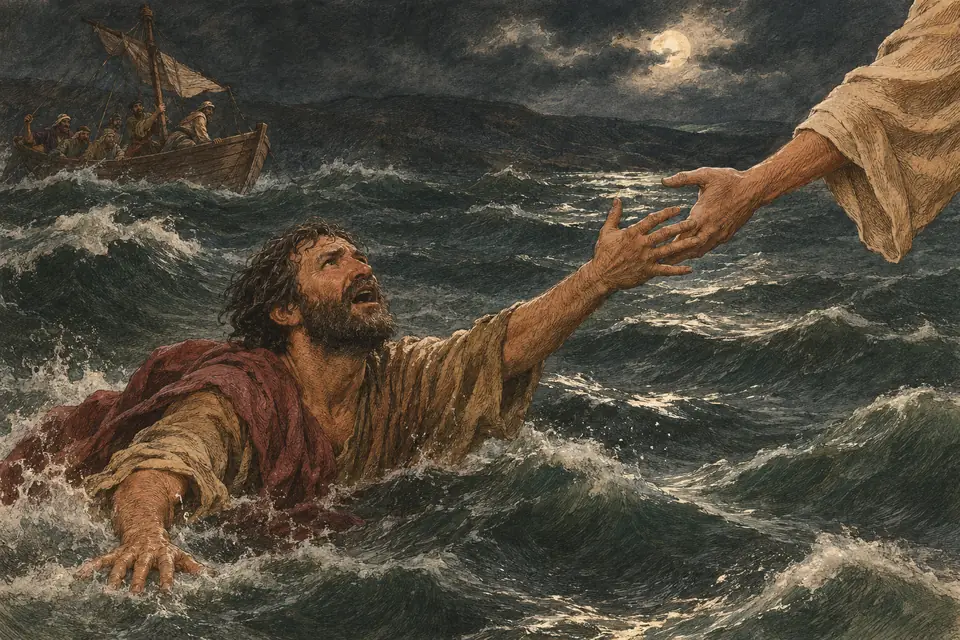
- 8.What caused Peter to be afraid? Verse 30, first part.
- 9.What was the result of this fear? Verse 30, middle part.
- 10.How did he seek help? Verse 30, last part.
- 11.What did Jesus immediately do? Verse 31, first part.
- 12.What did He say to Peter? Verse 31, last part. Note 3.
- 13.When they came into the ship, what happened? Verse 32.
- 14.What did those who were in the ship do? Verse 33.
- 15.To what place did Jesus and the disciples come? Verse 34.
- 16.What did the people of that place do? Verse 35.
- 17.What faith in Jesus' power to heal did they show? Verse 36, first part.
- 18.How was their faith rewarded? Verse 36, last part.
Notes
1. The night was divided into four watches of three hours each. "In the fourth watch" would therefore mean from three to six o'clock in the morning. From this record we may infer that Jesus spent most of the night in prayer, while the disciples had been battling against contrary winds, making so little headway that in the fourth watch they were only "in the midst of the sea."
2. The word translated "spirit" here is not the one generally used in the New Testament in such expressions as "Holy Spirit," or, "Ye know not what manner of spirit ye are of," or, "Her spirit came again." In these expressions, the word pneuma is used; but in this exclamation of fear by the disciples, the word used is phantasma, from which we get "phantom," with about the same meaning as "apparition" or "specter." In our language and time, the natural expression would have been, "It's a ghost." Just what the disciples thought it was, need not trouble us. It is sufficiently clear that they could not explain the phenomenon of a man walking on the sea, and as some of us might have done, called it a ghost. How cheering must the familiar voice of Jesus have seemed to them in their strait!
3. Peter's failure in the physical act of walking on the sea, was owing to the same thing that brings failure to us many times on the sea of life — doubt. It would seem to us an act of great faith to step out of a boat upon a rough sea in the darkness; but Jesus called it an act of "little faith" for a man to do what Jesus bade him, and with Jesus there personally to help. It makes all the difference in the world whether our faith is based on the definite word of God, or whether we look upon conditions around us that seem contrary. It makes as great a difference whether we attempt a thing in our own strength or with Jesus present to help.
Bible texts in this lesson
Matthew 14:24-36 · Matthew 14:24 · Matthew 14:25 · Matthew 14:26 · Matthew 14:27 · Matthew 14:28 · Matthew 14:29 · Matthew 14:30 · Matthew 14:31 · Matthew 14:32 · Matthew 14:33 · Matthew 14:34 · Matthew 14:35 · Matthew 14:36
My notes
Saved in this browser. Sign in to see your notes on other devices.