
Lesson 9 · March 2, 1907
The Complete Decree
Questions
- 1.Who first issued the commandment regarding the restoration and building of Jerusalem? .
- 2.How many kings helped to carry out the commandment? .
- 3.When and by whom was the first part issued? . What was embraced in this part of the decree? Note 1.
- 4.When and by whom was the second part of the decree issued? .
- 5.How does the decree of Darius compare with the decree of Cyrus? Compare with . Note 2.
- 6.How much time intervened between the decrees of Cyrus and Darius? . Note 3.
- 7.Who issued the third and last part of the decree? .
- 8.What do we find in this part of the decree that was not found in the other parts? . Note 4.
- 9.How much time intervened between the decree of Darius and the decree of Artaxerxes? . Note 5.
- 10.At what date did the command really go forth? . Note 6.
- 11.When was the decree of Artaxerxes issued? .
- 12.How long did it take Ezra to reach Jerusalem? .
- 13.To whom did Ezra deliver the decree? .
- 14.How much of the year had passed before the decree was delivered? . Note 7.
Notes
1. The decree of Cyrus made provision for the rebuilding of the temple and the establishing of the worship.

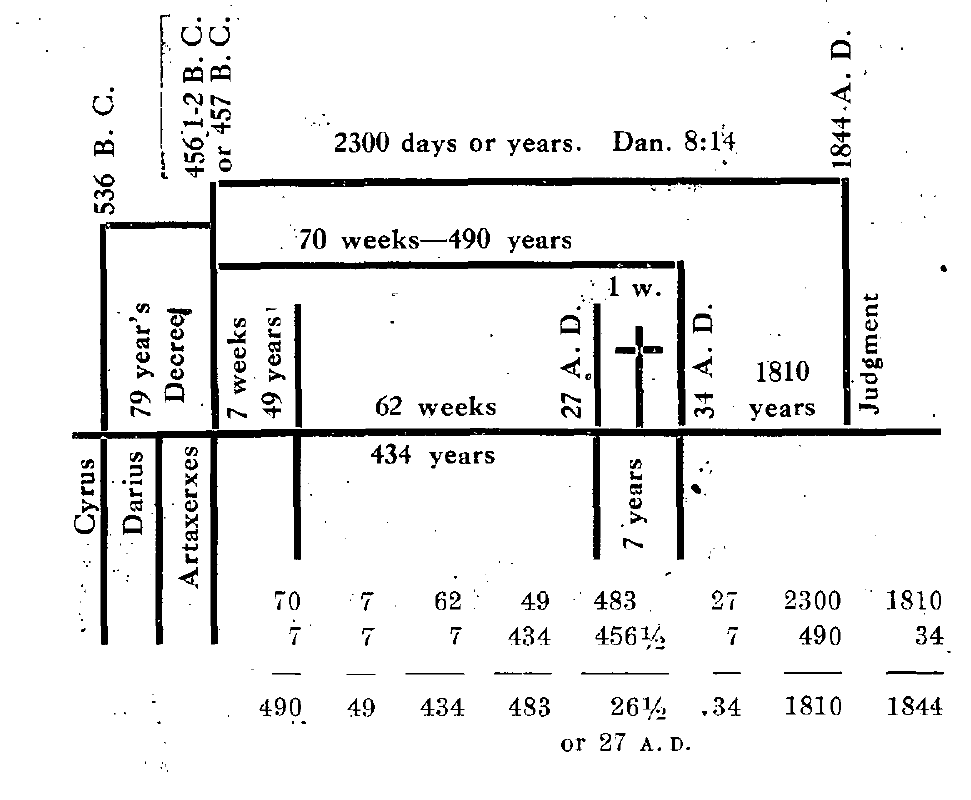
Chart as printed (PDF p. 17). Upper labels: "536 B. C."; "456 1-2 B. C. or 457 B. C."; "1844 A. D."; "2300 days or years. "; "70 weeks—490 years"; "79 year's Decree"; "7 weeks 49 years"; "62 weeks"; "27 A. D."; "1 w."; "34 A. D."; "1810 years"; "Judgment". Lower labels: "Cyrus"; "Darius"; "Artaxerxes"; "434 years"; "7 years". Figures along the foot, as printed (two numbers over a rule, then the result):
| 70 | 7 | 62 | 49 | 483 | 27 | 2300 | 1810 | |---|---|---|---|---|---|---|---| | 7 | 7 | 7 | 434 | 456½ | 7 | 490 | 34 | | 490 | 49 | 434 | 483 | 26½ or 27 A. D. | 34 | 1810 | 1844 |
2. The decree of Darius was a repetition of the one issued by Cyrus and embraced the rebuilding of the temple and the establishment of the worship.
3. By referring to the list of Persian kings given in Note 1, under Lesson VIII, it will be seen that seventeen years intervened between the first year of Cyrus and the second year of Darius the Persian.
4. Artaxerxes made provision for the establishment of the government. This was not mentioned by either Cyrus or Darius.
5. From the second year of Darius the Persian to the seventh year of Artaxerxes was sixty-two years. This, with the seventeen years between the decrees of Cyrus and Darius, makes seventy-nine years covered by the full decree.
6. Before the captivity, Jerusalem had a government as well as a temple and worship, and a decree to "restore and to build Jerusalem" must include the re-establishment of the government as well as the worship; therefore, the command could not be said to have gone forth until provision was made for the establishing of the government. This was in 457 B. C., in the decree of Artaxerxes.
The following taken from an editorial in the Review and Herald of April 5, 1906, contains important historical data on this question, and should be carefully studied:
According to the generally accepted chronology, the seventh of Artaxerxes was B. C. 457, as is noted in the margin of the Authorized Version of the book of Ezra; but, as is the case with almost every important doctrine, some have disputed this date, and have asserted that there was not sufficient proof to establish this important position. We have therefore thought it might be worth the while to bring forward some historical evidence bearing upon this question, evidence of such a character that it can not be set aside by mere assertion.
As the extract which we shall quote involves some abbreviations and expressions not now in common use in reckoning time, we will interpret some of them, so that all our readers may have as clear an understanding as possible of the grounds upon which the reckoning is based. The expression "An. 1, Olymp. 87" means "in the first year of the eighty-seventh Olympiad," and the expression "An. 4, Olymp. 88" means "in the fourth year of the eighty-eighth Olympiad," and the expression "An. 1, Olymp. 75" means "in the first year of the seventy-fifth Olympiad," and the expression "An. 4, Olymp. 83" means "in the fourth year of the eighty-third Olympiad." The Olympiad was "the period of four years between any two celebrations of the Olympic games," at Olympia in Elis, one of the States of Greece, the first Olympiad being reckoned from B. C. 776. Whenever the abbreviation "An. J. P." occurs, it may be interpreted, "The year of the Julian Period." This was "a chronological period of 7,980 years, combining the solar, lunar, and indiction cycles," which was given a theoretical starting-point in B. C. 4713. "The Julian Period was proposed by Scaliger, to remove or avoid ambiguities in chronological dates, and was so named because composed of Julian years." The abbreviation "lib." should be read "book." The expression "Anno Urbis Conditae 273" may be read "in the two hundred and seventy-third year from the founding of the city," referring to the founding of Rome in B. C. 754. The other abbreviations will doubtless be understood by the average reader.
The quotation to which reference has been made is from Part I, Chap. 10, of Sir Isaac Newton's work on the prophecies of Daniel, and reads as follows:
The grounds of the chronology here followed [to show that the seventh year of Artaxerxes was B. C. 457] I will now set down as briefly as I can.
The Peloponnesian War began in spring, An. 1, Olymp. 87 (B. C. 432), Diodorus, Eusebius, and all other authors agree. It began two months before Pythodorus ceased to be Archon (Thucyd. 1, 2), that is, in April, two months before the end of the Olympic year. Now, the years of this war are most certainly determined by the fifty years distance of its first year from the transit of Xerxes inclusively (Thucyd. 1, 2), or forty-eight years exclusively (Eratosth, apud Clem. Alex.); by the sixty-nine years distance of its end, or twenty-seventh year, from the beginning of Alexander's reign in Greece; by the acting of the Olympic games in its fourth and twelfth years (Thucyd. 1, 5); and by three eclipses of the sun and one of the moon, mentioned by Thucydides and Xenophon. Now, Thucydides, an unquestionable witness, tells us that the news of the death of Artaxerxes Longimanus was brought to Ephesus, and from thence by some Athenians to Athens, in the seventh year of the Peloponnesian, when the winter half-year was running, and therefore he died An. 4, Olymp. 88, in the end of An. J. P. 4289 (B. C. 425), suppose a month, or two, before mid-winter, for so long the news would be in coming. Now, Artaxerxes Longimanus reigned forty years, by the consent of Diodorus, Eusebius, Jerome, Sulpitius, or forty-one, according to Ptol. in Can., Clem. Alexand. (1. 1), Strom., Chron. Alexand., Abulpharagius, Nicephorus, including therein the reign of his successors, Xerxes and Sogdian, as Abulpharagius informs us. After Artaxerxes, reigned his son, Xerxes, two months, and Sogdian, seven months; but their reign is not reckoned apart in summing up the years of the kings, but is included in the forty, or forty-one years' reign of Artaxerxes; omit these nine months, and the precise reign of Artaxerxes will be thirty-nine years and three months. And therefore since his reign ended in the beginning of winter, An. J. P. 4289 (B. C. 425), it began between midsummer and autumn An. J. P. 4250 (B. C. 464).
The same thing I gather also thus: Cambyses began his reign in spring, An. J. P. 4185 (B. C. 529), and reigned eight years, including the five months of Smerdis; and then Darius Hystaspes began in spring, An. J. P. 4193 (B. C. 521), and reigned thirty-six years, by the unanimous consent of all chronologers. The reigns of these two kings are determined by three eclipses of the moon, observed at Babylon, and recorded by Ptolemy; so that it can not be disputed. One was in the seventh year of Cambyses, An. J. P. 4191 (B. C. 523), July 16, at eleven at night; another in the twentieth year of Darius, An. J. P. 4212 (B. C. 502), November 19, at 11:45 at night; a third in the thirty-first year of Darius, An. J. P. 4223 (B. C. 491), April 25, at 11:30 at night. By these eclipses, and the prophecies of Haggai and Zechary compared together, it is manifest that his years began after the twenty-fourth day of the eleventh Jewish month, and before the twenty-fifth day of April, and by consequence about March. Xerxes, therefore, began in spring, An. J. P. 4229 (B. C. 485), for Darius died in the fifth year after the battle of Marathon, as Herodotus (lib. 7) and Plutarch mention; and that battle was in October, An. J. P. 4224 (B. C. 490), ten years before the battle of Salamis. Xerxes, therefore, began within less than a year after October, An. J. P. 4228 (B. C. 486), suppose in the spring following; for he spent his first five years, and something more, in preparations for his expedition against the Greeks; and this expedition was in the time of the Olympic games, An. 1, Olymp. 75, Calliade Athenis Archonte, twenty-eight years after his regifuge and consulship of the first consul, Junius Brutus, Anno Urbis Conditæ 273 (B. C. 481), Fabio and Furio Coss. The passage of Xerxes' army over the Hellespont began in the end of the fourth year of the seventy-fourth Olympiad, that is, in June, An. J. P. 4234 (B. C. 480), and took up one month; and in autumn, three months after, on the full moon, the sixteenth day of the month of Munychion, was the battle of Salamis, and a little after that an eclipse of the sun, which, by the calculation, fell on October 2. His sixth year, therefore, began a little before June, suppose in spring, An. J. P. 4234 (B. C. 480), and his first year consequently in spring, An. J. P. 4229 (B. C. 485), as above. Now, he reigned almost twenty-one years, by the consent of all writers. Add the seven months of Artabanus, and the sum will be twenty-one years and about four or five months, which end between mid-summer and autumn, An. J. P. 4250 (B. C. 464). At this time, therefore, began the reign of his successor, Artaxerxes, as was to be proved.
The same thing is also confirmed by Julius Africanus, who informs us out of former writers that the twentieth year of this Artaxerxes was the one hundred and fifteenth year from the beginning of the reign of Cyrus in Persia, and fell in with An. 4, Olymp. 83. It began, therefore, with the Olympic year soon after the summer solstice. An. J. P. 4269 (B. C. 445). Subduct nineteen years, and his first year will begin at the same time of the year, An. J. P. 4250 (B. C. 464), as above.
Thus, by three independent lines of historical proof, Sir Isaac Newton shows that Artaxerxes began his reign in B. C. 464, and "the seventh year of Artaxerxes the king" would consequently be B. C. 457.
Bible texts in this lesson
Ezra 6:14 · Ezra 1:1-4 · Ezra 6:1-12 · Ezra 4:24 · Ezra 1:1 · Ezra 7:11 · Ezra 7:25 · Ezra 7:26 · Ezra 7:7-11 · Ezra 7:8-11 · Ezra 7:9 · Ezra 8:36 · Daniel 8:14
Your notes
Kept in this browser. Sign in to keep them on every device.